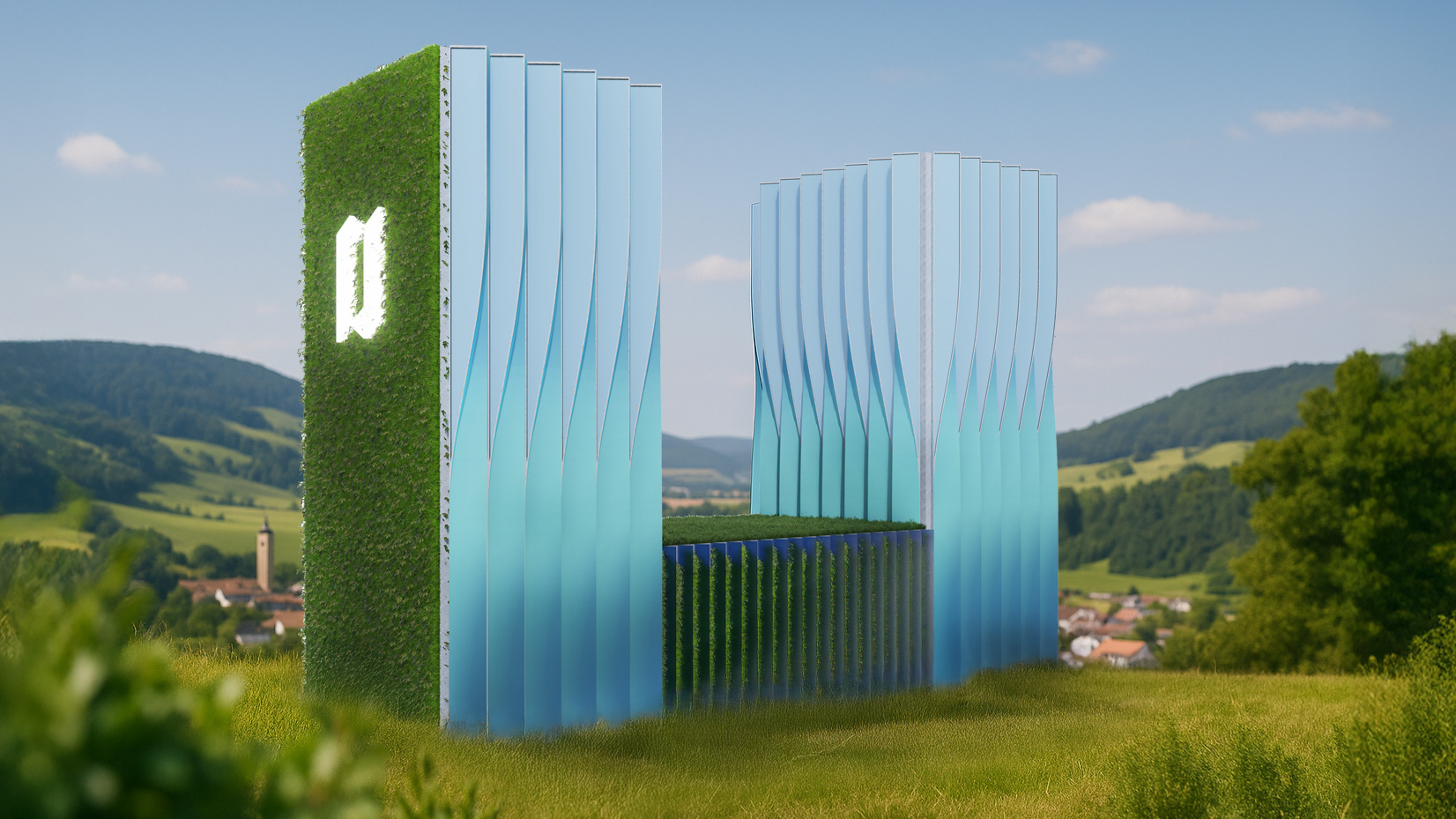
The planned vertical energy systems are designed to make clean, weather-independent energy available directly in urban areas—and to contribute to more livable neighborhoods through green facades.
Michelstadt, July 9, 2026 – Cities face a dual challenge: In the future, they will need significantly more clean energy right where it is consumed—and at the same time, they must become more resilient to heat, land scarcity, and rising demands for quality of life.
Traditional renewable energy infrastructure, such as large solar farms or wind turbines, often reaches its spatial limits in densely built-up urban areas. This is precisely where ENERGY TOWERS comes in: with a vertical, modular power plant technology designed to generate energy on a small footprint while seamlessly integrating architecturally into modern neighborhoods.
Vertical energy infrastructure with minimal land requirements
According to the company, ENERGY TOWERS’ patented technology utilizes the physical principles of buoyancy, gravity, and circulation mechanics in closed, vertical chambers. The system is designed for continuous energy conversion regardless of weather conditions and is therefore intended for use particularly in locations where security of supply, space efficiency, and decentralized energy supply are critical.
The vertical design is a key advantage: Instead of taking up large areas, the technology grows upward—or, depending on the project concept, can be partially integrated underground. As a result, ENERGY TOWERS opens up new possibilities for urban spaces, industrial sites, new residential districts, and large-scale infrastructure projects.
“We need to rethink energy infrastructure,” says Stephan Ballweg, CEO of ENERGY TOWERS. “A power plant of the future should not be an isolated, out-of-place structure on the outskirts of a city. Our vision is a decentralized energy infrastructure that is built where people live, work, and need energy—efficient, clean, and integrated into the architecture of modern neighborhoods.”
Green Facades as a Solution to Urban Heat
A defining element of the concept is the planned greening of the ENERGY TOWERS’ facades. It is intended not only to visually integrate the technical infrastructure into the cityscape but also to help improve the urban microclimate.
This issue is becoming increasingly important, especially in densely built-up cities. Asphalt, concrete, and impervious surfaces trap heat and can exacerbate the so-called urban heat island effect. Green facades can counteract this by providing shade, facilitating evaporative cooling, and improving the quality of life in the immediate surroundings.
In addition, plants can help purify the air, trap dust, and promote urban biodiversity. ENERGY TOWERS therefore views the planned greening not merely as a design decision, but as an integral part of a holistic infrastructure concept: energy generation, climate adaptation, and urban design should be considered more closely together in the future.
“The energy issue of the future is not just a technical one,” says Ballweg. “It is also a question of space, acceptance, and quality of life. If we want to bring new energy infrastructure into cities and neighborhoods, it must be functionally, aesthetically, and ecologically compelling.”
From Technical System to Urban Landmark
With its concept of green ENERGY TOWERS, the company is positioning itself at the intersection of energy, architecture, and urban development. The modular towers are not meant to be hidden away but rather to be deliberately viewed as visible infrastructure for the energy transition—as landmarks for resilient, decentralized, and sustainable neighborhoods.
This approach is particularly relevant for project developers, municipalities, industrial sites, commercial real estate, and modern residential neighborhoods. In these settings, energy infrastructure integrated at an early stage can help reduce dependence on the grid, use space more efficiently, and plan energy supply as an integral part of site development.
Pilot Plant as the Next Milestone
After more than ten years of research and development under the leadership of founder and CTO Zeki Akbayir, ENERGY TOWERS is preparing for the next phase of development. The planned construction of a first pilot plant is intended to further solidify the technological implementation and lay the foundation for future scaling efforts.
This brings the vision of vertical, green power plants closer to practical application: as a new form of decentralized energy infrastructure for urban development that combines security of supply, climate adaptation, and quality of life.
About ENERGY TOWERS
ENERGY TOWERS is the solution to the energy crisis: sustainable, independent and future-proof. The revolutionary technology enables environmentally friendly power generation directly on site – efficient, modular and independent of fossil fuels, wind or weather. ENERGY TOWERS utilise natural physical processes to convert renewable energy in a weather-independent and resource-saving manner.
The goal: to make clean electricity accessible to all and to create a world in which affordable renewable energy is the norm. With an interdisciplinary team of engineers, scientists and entrepreneurs, ENERGY TOWERS is driving the future of green power generation – for a sustainable and secure power supply worldwide.
More information at energytowers.de/en